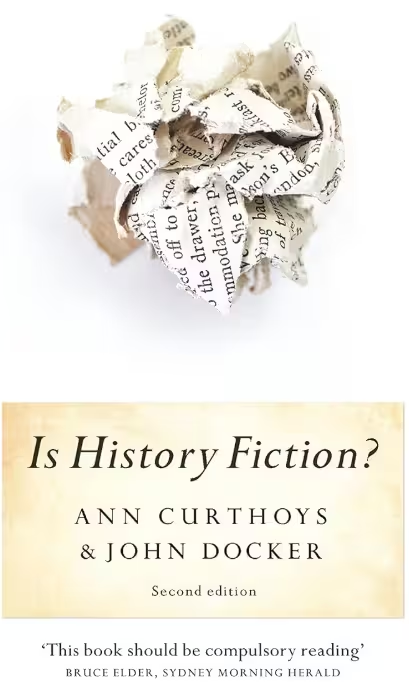
Is History Fiction? [book]
by Ann Curthoys and John Docker
This book gives an overview of the various approaches used when writing about history. What follows is a brief summary of the main points.
“Truth is a thing of this world: it is produced only by virtue of multiple forms of constraint. And it induces regular effects of power. [...] Truth is undoubtedly the sort of error that cannot be refuted because it was hardened into an unalterable form in the long baking process of history."
[Michel Foucoult, p489]
"We who live in the present did not create the violence and hatred of the past. But the violence and hatred of the past, to some degree, created us. It formed the material world and the ideas with which we live, and will continue to do so unless we take active steps to unmask their consequences."
[Tessa Morris-Suzuki, 2002, p. 581]
Factors that influence historical writing
- Gender
- Colonialism
- Victors usually write history
- Existing written history tends to be overwhelmingly from a European point of view
- History as preserving the state and culture (white, colonial, Christian, European dominance, the “Orient” as “the others”)
- History is embedded in the nation-state (or in various ideologies)
- History as anti-state
Ways of writing history
Thucydides: One narrative and one interpretation of each event, a quasi-scientific approach
Herodotus: History can be told from many points of view - conflicting ones can still be valid.
- Apply standards of today?
- Apply a moral compass?
- Interpret events?
- Produce a narrative?
- Top down history vs bottom up
- Historical fiction has a role
- Structuralism (looking at events in terms of how they fit into a larger structure)
- History as detective work - admit we don't know what happened and collect evidence
- Historians can't avoid using literary forms (like metaphor, or conjecture about thoughts or motives) when narrating an event.
- Historians can't ignore their own prejudices, culture, world view, funding
- Context-free history (or assuming reader knows the larger picture)
- Holy books - borrowed heavily from existing myths and legends. History with a purpose.
- Experimentation in history telling late 20th century, e.g. inspired by film flash back and flash forward
Examples of disputed history
- Gaza
- Apartheid South Africa - truth helped dismantle it, and truth and reconciliation tribunals helped to heal the country
- Jury TV shows
- Role of Irish & Scottish soldiers, and their wives at Battle of Waterloo
- What is a terrorist?
- Armenia genocide
- Climate change
- The Crown
- Downton Abbey
- US exceptionalism
- David Irling was a holocaust denialist. Deborah Lipstadt wrote a book debunking his conclusions. He sued in 2000 and she won. Implications for both sides-ism.
- Smithsonian exhibition about Hiroshima (1995 Enola Gay) - objections about morality and value of US lives
- Rape of Nanjing and history in Japanese school textbooks
- Tasmania frontier wars - whites deny it happened, or choose to ignore it
- Changi POW prison - piano and concerts (not all horror)
Posted by Murray. Last modified: 09 May 2026.